The Account Was Frozen. The Crypto Still Moved: What Unocoin and BitGo Reveal About Multisig Security
Unocoin froze its BitGo account, but unauthorized transfers still went through. Here’s how two independently held keys made that possible.


On November 6, 2026, Indian crypto exchange Unocoin detected suspicious activity and asked its infrastructure providers to freeze its enterprise accounts. BitGo confirmed the freeze. Yet the investigation later revealed unauthorized transactions that had been signed and broadcast outside BitGo’s platform.
By November 14, Unocoin had reported three compromised hot wallets and estimated losses of approximately $200,000. According to BitGo’s analysis of the affected Ethereum wallet, the reviewed transactions used two keys controlled by Unocoin. BitGo’s own signing key was not involved.
That creates a question worth examining: if the account was frozen, how could the assets still move? The answer lies in the difference between controlling a service account and controlling the keys that the blockchain accepts.
What Happened at Unocoin?
Unocoin used BitGo and Fireblocks as part of its digital-asset operations. The company’s public updates establish the following timeline:
- November 6: Unocoin detected suspicious activity and requested account freezes from Fireblocks at 11:24 UTC and BitGo at 11:29 UTC.
- November 9: After further unauthorized activity, Unocoin suspended its services.
- November 12: The exchange disclosed that it had identified outgoing transactions from an Ethereum address in its BitGo wallet infrastructure.
- November 13: Unocoin reported that the freeze appeared to have worked as intended and that the transactions had been signed and broadcast outside BitGo. BitGo published its analysis of the affected Ethereum wallet.
- November 14: Unocoin confirmed that three of more than twenty operational wallets had been compromised, with an estimated loss of around $200,000.
These dates and findings come from the companies’ own disclosures: Unocoin’s incident updates and BitGo’s signing analysis.
Unocoin said it would cover the identified loss from its own resources. It also warned of possible exposure of customer information, including email and residential addresses, encrypted passwords, KYC-related information and account balances. At the time of its November 14 update, the full extent of the infrastructure compromise was still under investigation.
How a 2-of-3 Multisig Wallet Works
A conventional single-key wallet can authorize spending with one signing key. A multisignature wallet distributes that authority. In a 2-of-3 arrangement, any two of three designated keys can authorize a transfer.
For the Ethereum wallet examined by BitGo, the key roles were:
| Signing key | Controller |
|---|---|
| User key | Unocoin |
| Backup key | Unocoin |
| BitGo key | BitGo |
Swipe the table sideways to see all columns
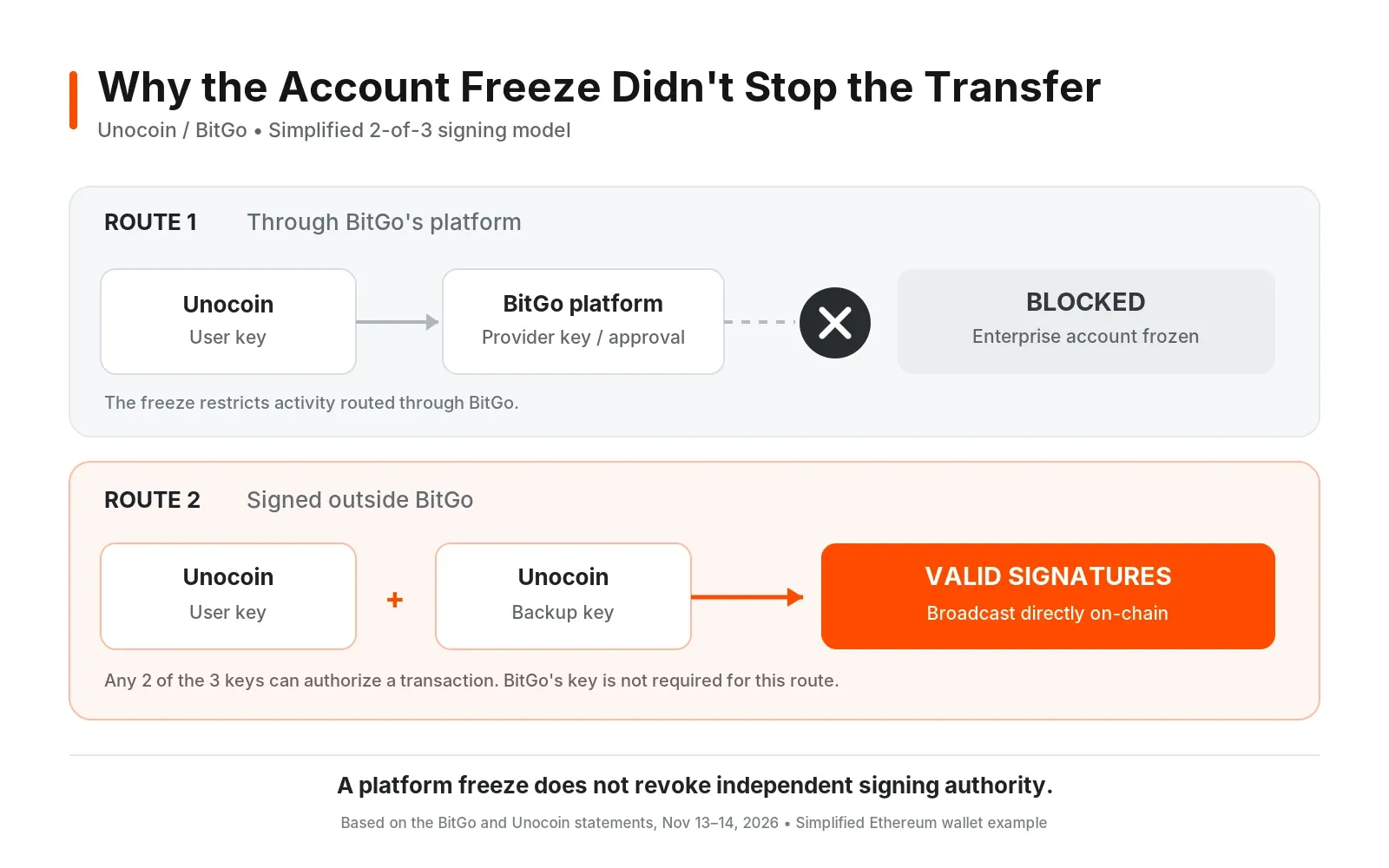
Any two keys could satisfy the threshold: user plus BitGo, backup plus BitGo, or user plus backup. That last combination is crucial. If Unocoin’s two keys were available, a valid transaction could be signed without BitGo’s participation.
This is not necessarily a flaw in multisig. In this model, the recovery path intentionally preserves the customer’s access if the provider becomes unavailable. But provider independence also means the provider cannot veto every possible signing path.
Why the Account Freeze Did Not Stop the Transfers
An account freeze restricts what can happen through the provider’s own infrastructure. It does not automatically change the transaction authorization rules enforced by a blockchain or wallet smart contract.
BitGo stated that normal withdrawals from the affected Ethereum wallet used Unocoin’s user key together with BitGo’s key, with the provider’s checks and configured policies applied before BitGo signed. The user-plus-backup route, however, was independently available.
BitGo’s analysis identified the user and backup signatures in the reviewed Ethereum transactions. According to the company, the transactions were broadcast directly to the blockchain, with no corresponding initiation records on BitGo’s platform. Its key was not used in those transactions.
This separates two kinds of controls:
- Service-level controls govern activity routed through a provider, such as account freezes, withdrawal reviews and platform policies.
- Cryptographic authorization determines which combinations of keys can produce a transaction the blockchain will accept.
If the required signing authority exists outside the provider, freezing the provider’s account does not revoke that authority. This conclusion applies to the configuration described here, not to every system marketed as multisig. Smart-contract rules, key distributions and additional controls can vary significantly.
The Backup Keys Were About Eight Years Old
Unocoin’s November 14 update added an important detail. Its encrypted backup keys had been generated roughly eight years earlier, printed on paper and placed in secure physical storage.
The company said those backup keys had been compromised and used to authorize unauthorized transfers. It also disclosed that the passphrase needed to decrypt the printed encrypted keys existed in compromised infrastructure.
But the precise route to the backup keys remains unknown. The presence of a passphrase on compromised systems does not, by itself, establish how the encrypted backups were obtained or used. It would be premature to claim that an attacker accessed the physical storage, stole paper documents or exploited a specific software vulnerability.
The broader lesson is clear even while the forensic investigation remains open: a rarely used backup key can still carry full signing authority. “Backup” describes its intended role, not a reduced level of privilege.
The Trade-Off Behind Provider Independence
The ability to recover funds without a provider is a major benefit of self-custody. If a vendor goes offline, closes accounts or cannot co-sign, the owner can retain control through other authorized keys.
That resilience comes with another possible signing path. When one organization holds two keys that together meet a 2-of-3 threshold, security depends on whether those keys are genuinely protected against the same failure or attack.
Separate physical locations help, but they do not automatically create independent security boundaries. If one compromised environment can expose the information needed to access both keys, the apparent separation may be weaker than expected. Conversely, multiple keys are still valuable when access, custody and recovery procedures have been designed to resist correlated failures.
The number of keys is not the whole security model. The combinations that can authorize spending, and the ways each key can be reached, matter just as much.
Five Questions Every Self-Custody Setup Should Answer
- Which keys can actually move the funds? Map every valid signing combination, not only the one used in ordinary withdrawals.
- Is the recovery route genuinely independent? Consider both the encrypted backup and any passphrase, credentials or systems needed to use it.
- What happens if the primary environment is compromised? Evaluate whether an attacker could combine access to ordinary signing material with backup credentials or keys.
- Which rules exist only inside a service? Find out whether a freeze, withdrawal limit or approval requirement also applies to transactions signed outside that service.
- Has recovery been tested safely? A backup process must be usable when needed without making routine compromise easier.
These questions matter to individuals as well as exchanges. The details of their threat models differ, but both need to understand who can assemble sufficient signing authority.
Was This a Failure of Multisig?
Not on the evidence currently disclosed. The examined transactions appear to have used a key combination that the wallet architecture was designed to accept. That is different from breaking the multisignature cryptography.
BitGo said its infrastructure was not compromised and its key did not participate in the reviewed Ethereum transfers. Unocoin said its own backup keys had been compromised. These are findings and statements from the involved companies, not a completed independent reconstruction of every step of the attack.
It is important to keep two questions separate: did the system validate signatures according to its rules, and should an attacker ever have been able to obtain those signatures? A design can behave as specified while still leaving a real-world security gap in the protection of signing material.
The Real Lesson: Map Control, Not Just Key Counts
The Unocoin incident illustrates a central tension in self-custody. Independent recovery can protect the owner against provider failure, but that same independence limits what a provider can stop.
Backup keys are not passive paperwork. If they can authorize spending, they are active components of the security boundary even when stored for years and rarely used.
The decisive question is not simply how many keys protect a wallet. It is who can assemble a valid combination, through which paths, and what prevents an attacker from doing the same.
Understanding who controls the keys is the first step toward better self-custody.
Use the code below for 20% off.