Your Own Server Doesn't Guarantee Crypto Security: The BTCPay Server Lesson
Owning your crypto payment server doesn't necessarily protect your keys. Here's what the BTCPay Server incident teaches us about self-custody.

Imagine running an online store that accepts Bitcoin directly. No banks, no payment intermediaries, and no third party holding your funds. You manage the server, process payments, and control the infrastructure yourself.
But what happens if someone compromises that server? Can they merely view your transactions, or can they actually move your money?
That distinction is at the heart of the recent BTCPay Server security incident.
What Happened to BTCPay Server?
On November 1, 2026, reports emerged of unauthorized Bitcoin and Litecoin withdrawals from hot wallets connected to BTCPay Server, an open-source platform for accepting cryptocurrency payments.
In its official November 2 statement, the BTCPay team confirmed that the attacks targeted installations running version 2.4.1 or earlier. The underlying vulnerability had been fixed in August, but attackers found a different way to exploit it.
According to blockchain analysis by Bitquery, approximately $1.63 million in Bitcoin and Litecoin was traced to addresses associated with the incident. This is an on-chain estimate, not a confirmed final loss figure.
But the most revealing detail wasn't the amount stolen.
BTCPay confirmed that the thefts involved hot wallets whose spending keys were stored on the server. Wallets that kept their keys elsewhere, including hardware wallets, were unaffected by these thefts.
Why did the same platform expose funds in one configuration but not another?
Accepting Crypto and Spending It Are Two Different Things
When an online store accepts Bitcoin, its payment server generates payment addresses, monitors incoming transactions, and confirms payments.
None of these operations requires access to private keys. As BTCPay's wallet documentation explains, public wallet information is sufficient to generate receiving addresses and track transactions.
Sending funds is different. It requires a valid cryptographic signature, created using private keys.
This leads to two fundamentally different approaches.
Hot wallet: convenience with additional exposure.
A hot wallet keeps the keys needed to spend funds on an internet-connected server. Transactions can be signed automatically, making refunds and payouts easier.
But if an attacker gains sufficient access to those keys or the signing mechanism, they may be able to move funds without the owner's authorization.
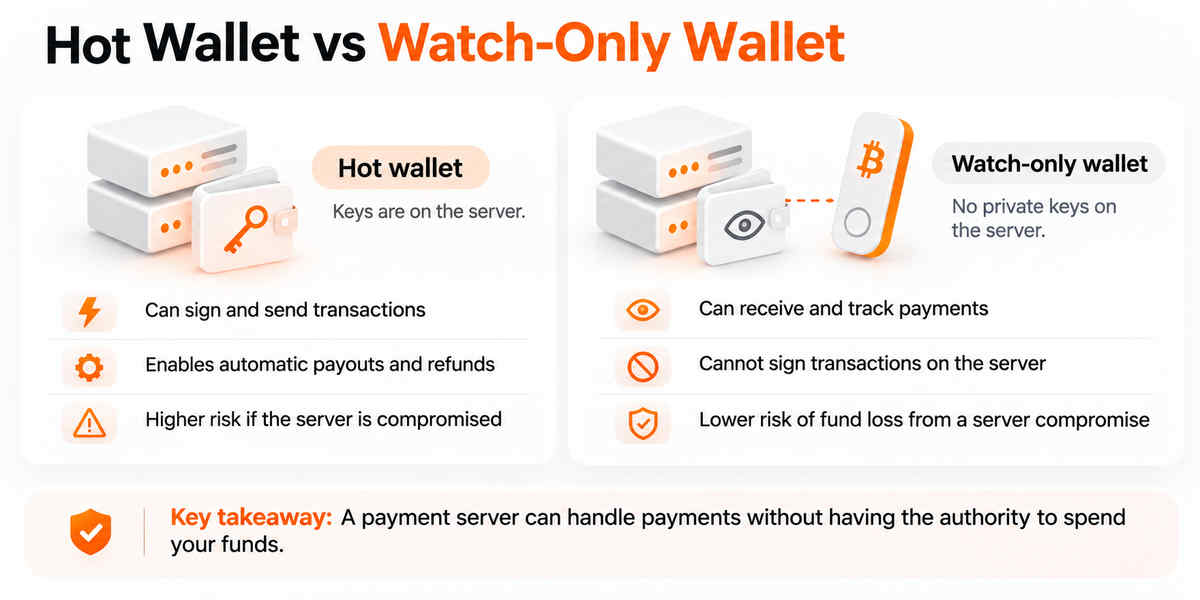
Watch-only wallet: visibility without spending authority.
A watch-only wallet lets the server monitor incoming payments without holding the private keys needed to spend them. Transactions must be signed separately, for example using a hardware wallet.
Even if the server is compromised, access to that server alone is not enough to sign transactions with keys held elsewhere.
This is the critical distinction: a server can handle payments without having the authority to spend the money.
However, watch-only configurations don't eliminate every risk. A compromised server could still display a fraudulent payment address or misleading transaction information.
That's why protecting private keys and independently verifying transaction details are equally important.
Why Updating Software Isn't Always Enough
When a vulnerability is discovered, installing an update seems like the obvious solution. And it is essential. But there's a catch.
Imagine someone entering your office through a faulty door and making a copy of your safe key. You repair the door. The original weakness is gone, but the attacker still has the key.
Cryptocurrency security works much the same way.
If private keys or a recovery seed were copied during an attack, updating the software cannot make them secret again.
That's why BTCPay's recovery guidance advises operators of affected older installations to move remaining funds to a new wallet with a fresh seed, rebuild the server in a clean environment, and replace potentially exposed credentials.
The principle extends far beyond this particular incident.
Patching a vulnerability can prevent further exploitation. It cannot undo a compromise that has already happened.
What Does This Mean for Self-Custody?
The BTCPay Server incident doesn't prove that self-custody is unsafe. It demonstrates why the architecture behind self-custody matters.
Owning your server gives you control over your infrastructure. It doesn't automatically isolate your private keys from that infrastructure.
This is where separating payment processing from transaction signing becomes valuable.
With an air-gapped hardware wallet, for example, private keys remain on a separate device without a direct internet connection. A connected system can prepare a transaction, but authorization requires a separate signing step.
The user must still verify what they are signing. Otherwise, even isolated private keys cannot prevent someone from approving a malicious transaction.
For businesses that depend on automated payouts, hot wallets may still be the practical choice. The priority then becomes limiting how much value is exposed to a compromised server.
The broader lesson is simple:
Security isn't defined by who owns the server. It's defined by where the private keys live and what happens when that server can no longer be trusted.
Self-custody isn't just about controlling your infrastructure. It's about understanding exactly which parts of that infrastructure have the power to move your money.

Explore how the ERA Wallet keeps signing separate from an internet-connected environment. Code ERABLOG20 for 20% off.